
for AV integrators
Run your client work. Build a book that renews.
The room you install today is a one-time invoice. Run it as a managed service and it renews every year. Your relationship, your margin, our platform underneath. Pick the tier that fits how you sell, then stack recurring services on top.
Apply to the partner programwhy this matters
Recurring revenue is worth 3-4x project revenue at exit.
The shops getting bought at the best multiples are not the ones with the biggest install backlog. They are the ones with the deepest book of service contracts. ApexAV is how you build that book without standing up a monitoring stack of your own.
Stickier customers
A client on a service contract doesn't go shopping for another integrator. They just renew.
Higher valuation
Buyers pay 2-3x on project revenue, 8-12x on recurring. Same client, very different multiple.
Zero infra cost
Nothing to build. ApexAV already syncs Cisco Control Hub and Logitech Sync, reaches Mersive pods through a lightweight on-site agent, and has MS Graph, Q-SYS Reflect, and Tesira on the roadmap.
Refresh pipeline
Lifecycle data flags the next refresh 12-18 months out. You see it before the client does.
Revenue multiples and valuation figures above are illustrative industry ranges, not a guarantee of any outcome. Actual results vary by deal.
two starter tiers
Pick the model that matches how you sell.
Two tiers, no haggling. Applications are open now.
Tier 1 · recommended
Authorized Integrator
You own the relationship. You quote, sign, and handle Tier 1 support. You bill the client, we bill you at the discount. For shops that already have the trust and want the whole experience in their hands.
25% off MSRP · your discount
Deal-reg. First to register, protected for a 90-day window, per partner agreement.
Tier 2 · no-friction
Referral Partner
You make the introduction. We take it from there, quote, sign, bill, support, and you get paid monthly while the customer remains active, per the partner agreement. Good when you spot the occasional ApexAV-shaped deal but have no appetite for another SaaS relationship to manage.
10% recurring · your commission
Recurring term. While the customer pays, you get paid, per the partner agreement.
Managed Service Provider (MSP) and white-label tiers are on the Phase 3 roadmap. Already running an MSP practice and want to talk early? Say so in your application.
managed service playbook
Ten services you can productize on top of ApexAV.
No need to invent a service catalog from a blank page. Here are ten that map straight to ApexAV features. Treat them as templates. The prices are starting points, you set your own.
service 01 · health audit
Quarterly room health audit
Your rig covers the signal path: EDID, Dante subscriptions, DSP presets. ApexAV covers the fleet: Cisco and Logitech status, warranty and lifecycle, and the record of every check. The output is a branded PDF you deliver to the client every quarter.
Priced per program.
service 02 · pre-meeting
Remote pre-meeting room check
Boardroom 12 has a 9am. ApexAV runs an 8:30 pre-flight on a schedule you set: devices online, codec paired, room healthy. Pass emails the EA a green check. Fail emails your list, and someone's in the AV closet before the meeting starts.
Priced per program.
service 03 · firmware
Firmware compliance + patch service
ApexAV surfaces stale firmware across the whole fleet: any unit running behind the newest version of the same product you own gets flagged. You run the updates in the agreed maintenance window and the work files into the audit trail.
Per-update or retainer.
service 04 · warranty
Partner warranty & RMA management
A device fails and you run the Cisco/QSC/Tesira RMA chase for the client. Asset tag, serial, warranty status, purchase order are already in ApexAV. The client never sees the partner-portal mess.
Monthly retainer.
service 05 · as-built
Annual as-built refresh
Walk the building once a year. Update the line diagrams and asset inventory in ApexAV, export the drawing, and deliver a fresh closeout bundle: diagrams, IP schedule, DSP configs, training docs. New people, new gear, documentation that matches the room.
Annual flat fee.
service 06 · lifecycle
Lifecycle + refresh planning
ApexAV knows the install date and warranty expiration of every device. You turn that into a 3-year refresh roadmap with budget. The client gets a forecast. You get first look at the install pipeline 12-18 months out.
Annual consulting + drives future install rev.
service 07 · sla
SLA monitoring with credits
Offer an uptime SLA and let ApexAV be the source of truth that measures it. The SLA tracker (Phase 3 dev pipeline) catches breaches and writes the service credit reports for you.
Monthly + service credits.
service 08 · compliance
Compliance evidence collection
For clients with SOC 2 / HIPAA / NIST obligations, the audit trail is the evidence. You package it for the auditor: change-management logs, access-control snapshots, partner list, patch records. Audit-ready PDF in an hour.
Annual compliance fee.
service 09 · decommission
Decommissioning audits
A floor or office is closing. You walk it, decommission in ApexAV, and hand finance and IT an audit-trail PDF: asset disposition, serial wipe confirmations, partner notifications, recycle docs.
Per-site flat fee.
service 10 · EBC premium
Executive Briefing Center pre-flight
The VIP version. Before every executive visit you check the EBC rooms: codecs paired, signage rendering, lighting cued, room scheduled right. A white-labeled report goes to the EBC manager after each event (coming soon).
Premium retainer.
How this stacks
You don't pick one. Authorized Integrators usually run 3 to 5 of these per client, bundled into tiers (Bronze / Silver / Gold). One ApexAV license powers all of them. Your margin lives in the service wrap.
run it across every client
One identity for your shop. A separate tenant for every client.
A practice is only worth selling if you can deliver it at scale. The tiers and the playbook are the offer. This is the product that makes the offer real.
One login
Your shop keeps one identity across every client. Switch in a click.
A tenant each
Each client gets their own projects, partners, compliance picture, and audit trail.
Scoped partners
Your client's other partners each see only their own work. Nobody sees anybody else's rates.
Clean renewals
Client A's licenses don't show up on Client B's renewal calendar.
access your client controls
Real access, because the client stays in charge of it.
Your client grants your org each part of ApexAV at the level that fits: view it, work in it, or manage it. Across the whole workspace or scoped to one project. That control is exactly why they can say yes to giving you real access, and why the "can you just get our integrator a login" meeting stops happening.
Open to partners today
What's coming
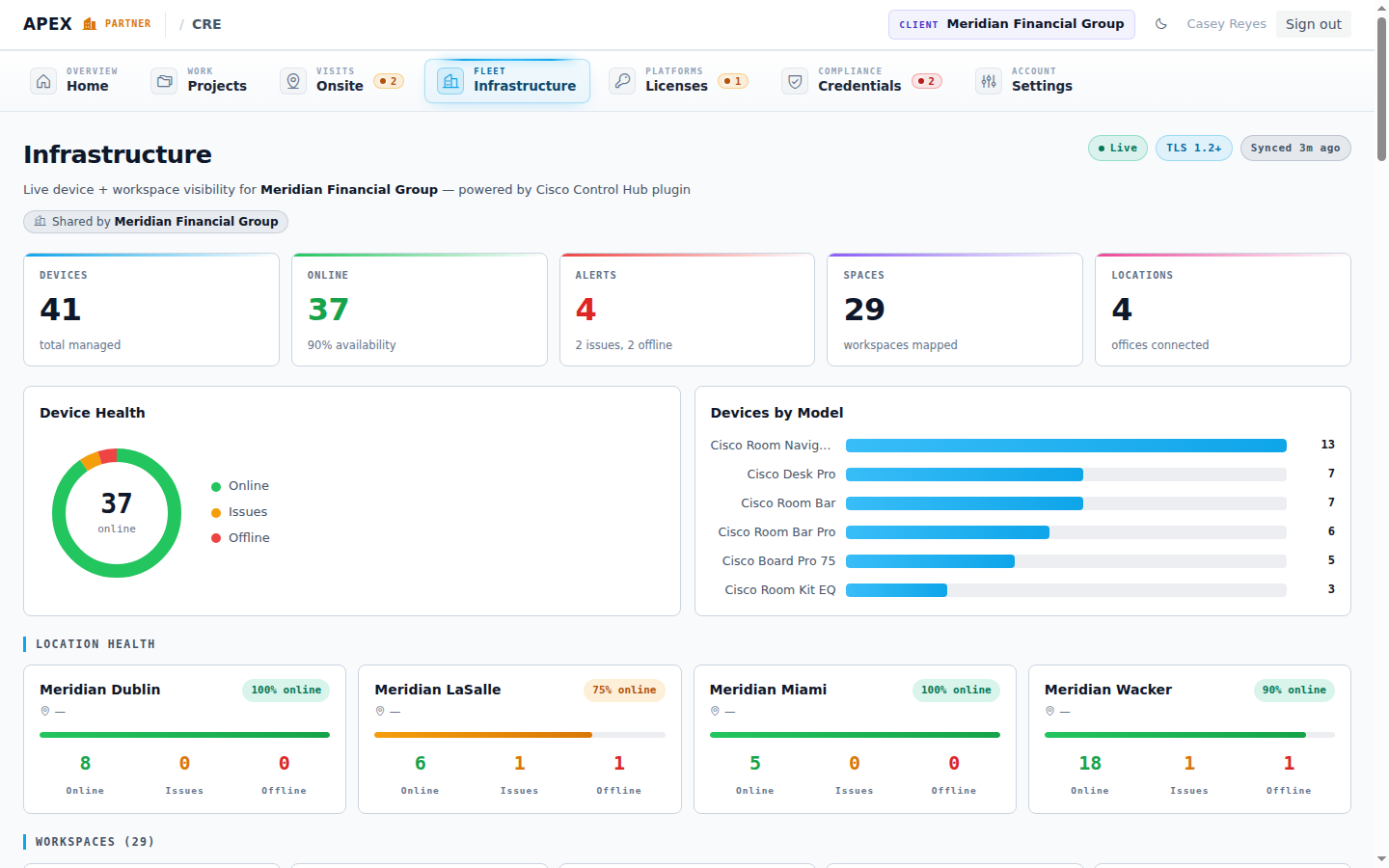
the fleet your client shared
see it
Their fleet, your screen
When a client opens Infrastructure to you, this is what you get: every device, live health by location, and the shared-by badge that says exactly whose fleet you're looking at.
how the work flows
Run every client job the same way.
From the first proposal to the renewal, in one system.
Propose
Propose an onsite visit with dates and scope.
Approve
The client approves or counter-proposes dates.
On site
Mark on-site, capture photos and video from the field.
Close out
Mark done; everything files into the project record.
Manage
Track devices, licenses, and renewals as a service.
see it
Every client job on one list
Status, the client's PM, and the due date for every project you're on, with the shared-by badge naming the client so nothing mixes between accounts.
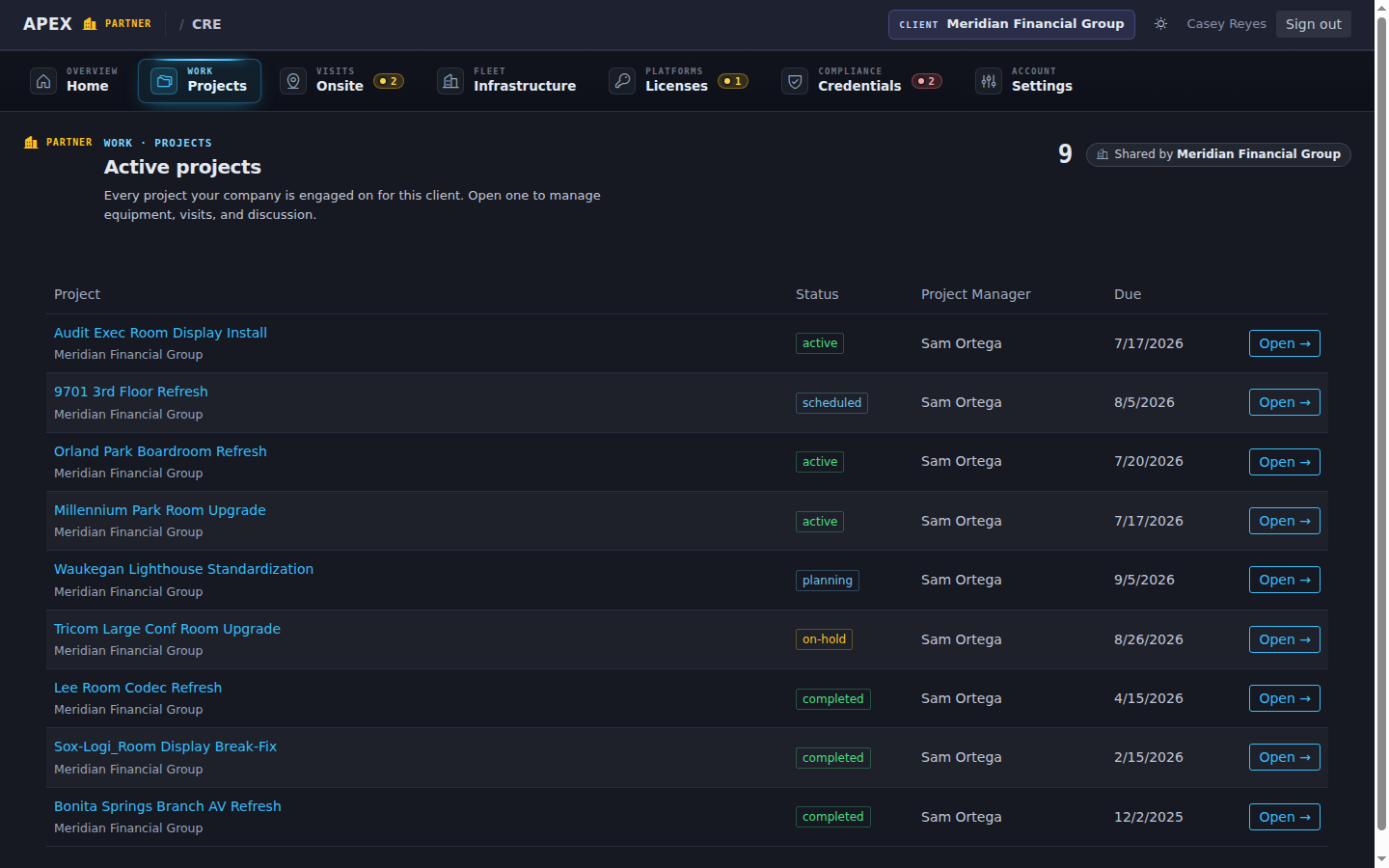
the partner projects list
problems we hear weekly
The job, the way you actually run it.
Phased tasks, inline status, the whole job on one page. Same data, different lens for the techs who work it and the client who reads it.
"Where's the punch list for Conf 18-East?"
Right now it's in an email thread, a sheet your PM owns, or someone's head. In ApexAV the open commissioning items live on the room. You close them out and attach the photo of the rack you actually did.
"Did the field tech actually go yesterday?"
The visit logs with a timestamp, GPS, and a photo from inside the closet. Asset tag scanned on arrival, EDID test logged at finish. The trail shows whether they did the work.
"Are we under budget on this project?"
Budget rollup at room, project, and portfolio level. Burn-down at a glance. PMs see drift the same week, not the following month. Approved-vs-deployed BOM diff is one column away from cost.
"The client wants a status report by Friday."
One filter, one export. Project health or per-room status, good enough to leave behind. Branding it with your shop's logo through the partner portal is coming soon. No more screen-shotting Smartsheet at 4:55 PM.
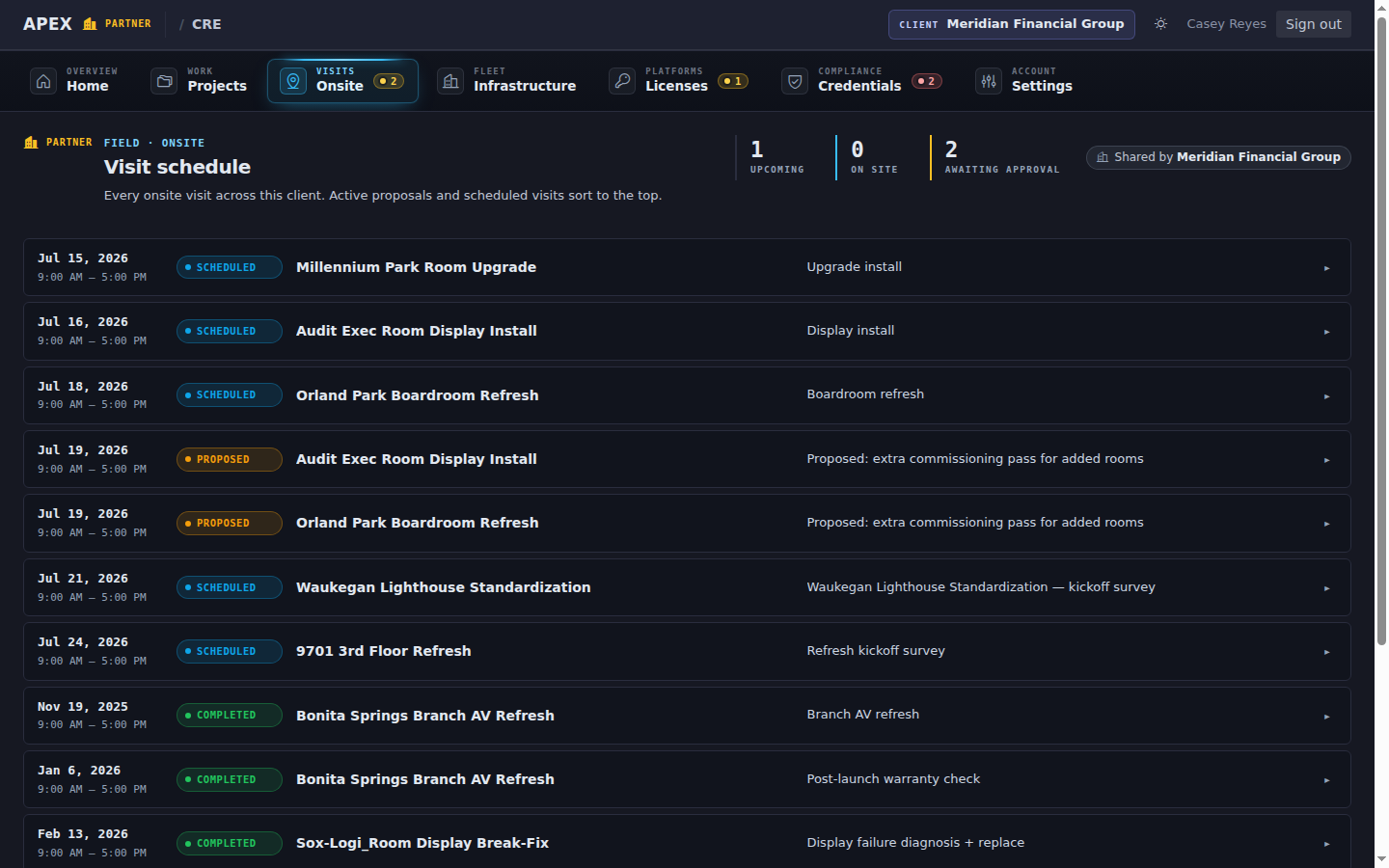
onsite visits, proposed and approved
see it
The visit trail, both sides on it
Propose the date, the client approves or counters, the tech marks on-site. The whole exchange lives here instead of a thread called RE: RE: RE: Tuesday?
collaboration in action
One thread per work item. Both sides on it.
Every project, every equipment line, every room, every work order has its own thread. Client and partner post into the same one. Status moves, @mentions cross the boundary, attachments pin to the item they belong to. The "did you see my message" follow-ups stop.
On the thread
What's coming
legal & compliance
The carve-outs we'll be upfront about.
Channel revenue share is standard for commercial B2B SaaS. A few deal shapes carry restrictions, though, and you should know them before you bring one in.
Healthcare, federal, state-government
The US Anti-Kickback Statute (healthcare) and FAR (federal contracts) limit referral fees on some deals. Those route through direct sales, or you get paid for services you actually deliver instead of a pure referral. We tell you which, deal by deal.
Owner's reps & construction managers
With a fiduciary duty to the end client (CM-at-risk, owner's rep), you have to disclose any revenue share to them. That's normal for the role. We hand you boilerplate disclosure language to use.
SOC 2 / data-residency contracts
Some existing customers have language about subcontractors and subprocessors. It does not block channel sales, but a partner pitching into a competing bank or carrier can trigger a contract review. We flag it during deal-reg.
Become an ApexAV partner.
Tell us about your shop and the clients you serve. We come back within two business days with the partner agreement and a call to walk the Managed Service Playbook against your actual accounts.